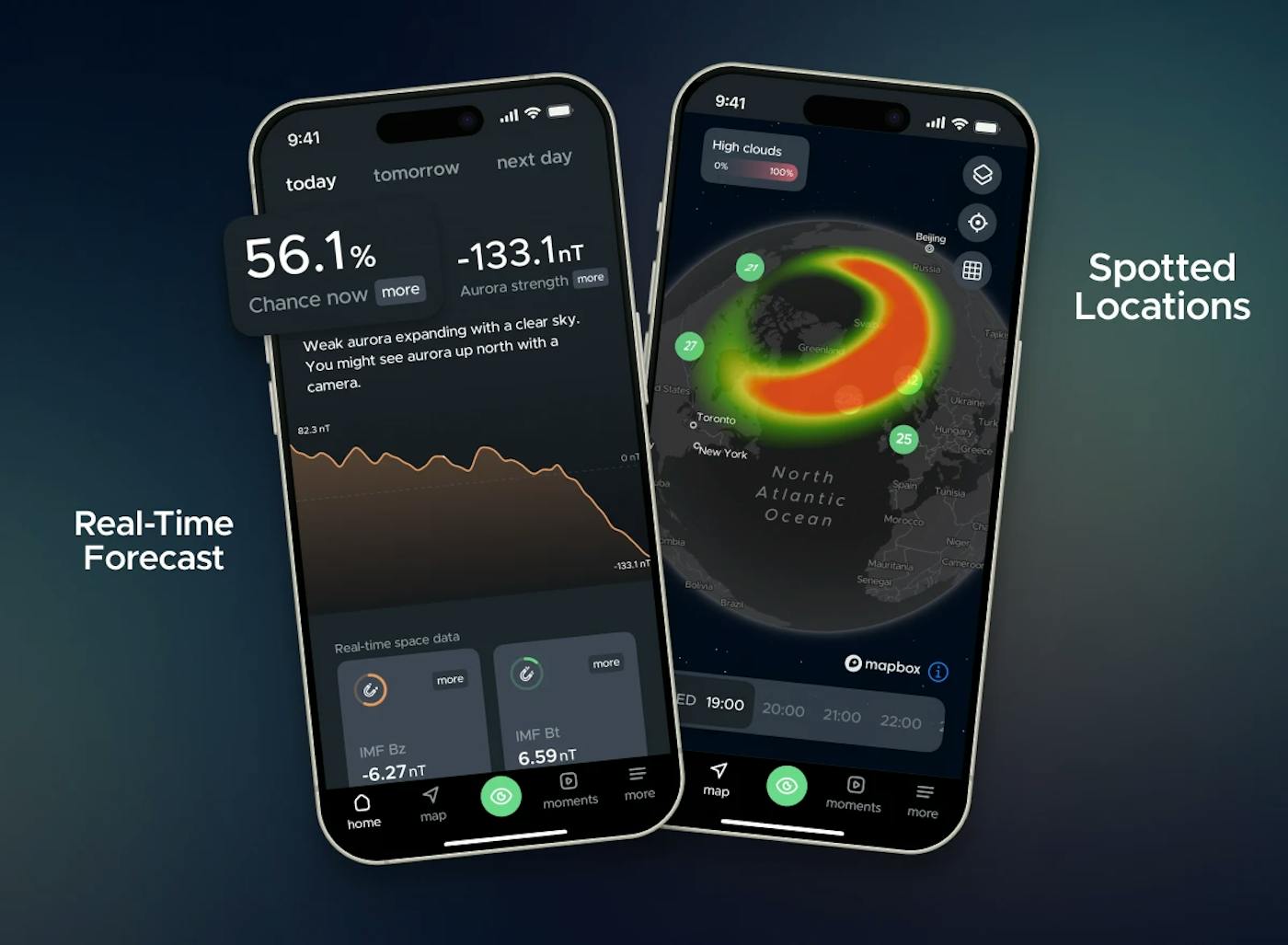
How to read the aurora forecast
Chasing the lights should not feel like guesswork. Hello Aurora pulls live space weather data and turns it into simple numbers you can act on. Here are the metrics that matter most.
Aurora Strength
Aurora Strength is a real-time measurement used to predict how active, bright, and visible the Northern Lights are at any given moment. Think of this as the main "go or no-go" signal. It measures real-time changes in Earth’s magnetic field caused by solar activity.
The aurora are caused by streams of charged particles from the sun smashing into Earth’s magnetic field. When this happens, it causes the magnetic field to vibrate, bend, and fluctuate. Magnetometers detect these fluctuations and record them in a unit called nanoteslas (nT). The bigger the fluctuation in nanoteslas, the more intense the aurora display will be. Aurora Strength on Hello Aurora app is geolocalised and comes from each countries geospatial agency.
What it tells you:
- When it drops sharply (around -150 nT): A "substorm" is happening. The lights are likely actively dancing right now. The lower this number goes, the wilder and brighter the show will be.
- When it spikes up (around +150 nT): The aurora is "charging up." Get your camera ready, because a display is often just minutes away.
- When it hovers near zero (around 5 nT): The skies are temporarily quiet. Time to grab a warm drink and wait.
Real-Time Solar Wind (RTSW)
Real-Time Solar Wind, or RTSW, is live solar wind data published by NOAA's Space Weather Prediction Center from SOLAR-1. SOLAR-1 replaced the older DSCOVR satellite in mid-2026 and gives forecasters 15 to 60 minutes of lead time before the solar wind reaches Earth. Full technical details are on NOAA's site.
This lead time matters for aurora hunters, and it is why we build our forecast on official RTSW data. Hello Aurora reads this feed directly from NOAA, so your forecast updates as the real numbers change.
The Interplanetary Magnetic Field, or IMF, is the sun's magnetic field traveling through space as part of the solar wind. Two numbers from RTSW data matter most for aurora hunting.
IMF Bz (The Direction)
Bz measures the north-south direction of the magnetic field. When Bz points south (showing as a negative number), it connects with Earth’s magnetic field near the poles and creates the conditions needed for an aurora.
- What to look for: Look for a negative Bz number. The further below zero the number goes, the higher your chances of seeing a display.
Note that, when Bz is negative it opens the "door" in the North pole and when it's positive it opens the door at the south pole. - Good conditions: A Bz of -10 nT or lower.
- Best conditions: A Bz of -15 nT or even lower (such as -20 nT). Deeply negative numbers produce the strongest, most vibrant auroras.
Solar Wind
Just as you feel the wind more strongly when walking outside on a breezy day, the same principle applies to the solar wind.
The faster the solar wind travels toward Earth, the more energy it transfers into the planet’s magnetic field. This increases the likelihood that the aurora will become brighter, more dynamic, and more visible in the night sky.
Monitoring solar wind speed is an important factor for predicting when and where the Northern Lights will put on their most spectacular displays.
Real-time metrics summary