What is the Best Northern Lights Forecast Tool for 2025 - 2026

Blog

What is the Best Northern Lights Forecast Tool for 2025 - 2026's cover picture

Aurora forecast tell you your chance of seeing the Northern Lights tonight by helping you understand and see predictions of current and upcoming aurora activity.

Aurora Borealis is a natural phenomenon, and the prediction cannot be 100% accurate. While there is no tool that can tell you precisely when, where, and exactly how you will see the lights. A good tool uses real-time data, the most accurate way to track the Northern Lights.

These are Northern Lights forecast tools that are widely used by people. This can help you identify and choose which is the best partner for your long aurora chasing nights for maximum chance.

In this article, you will learn:

  • Key features to look for when choosing Northern Lights forecast and alert tools
  • A breakdown of tools with pros and cons

How to pick the best aurora forecast and alert tools

We spent time testing each platform and app on the list to determine which ones stood out.

While testing the tools, we focused on the primary objective, which is the feature, the metrics and the experience when hunting for aurora. Specifically, whether they provided everything needed, such as:

  • Identify metrics used in the tool
  • Provide information and explanations on how easy the tools are. Things like how well-formatted the interface is and whether the platform has helpful walkthroughs or guides
  • Deliver notifications and alerts
  • Offer other features to help with aurora hunting

Key features to look for in aurora forecast tools

These are the key factors that are important to see the Northern Lights:

Real-time data not KP index

Look for aurora forecast tools or apps that offer real-time data and do not entirely focus on the KP index. This includes information such as solar activity, Bt, Bz, substorms, solar density, and IMF information.

You should not use the KP index, because it is not real-time data and was not initially used for aurora prediction. It's an average scale from 0-9 around the globe and updates every 3 to 6 hours. It also takes into calculation locations that are not in the aurora zone which makes it inaccurate and unreliable.

Read here why you should not focus on the KP index.

Easy explanations and user-friendly interface

Prioritize tools that have easy-to-understand explanations and give you a clear understanding of aurora forecasts.

Location-based alerts and notifications

Aurora alerts and notifications are also important comparisons as features. Look for tools that give you location-based notifications which take into the calculation of weather forecast, clouds, astronomy, and solar activity at your location, not on a global scale.

Ease of use and ad-free experience

Another thing to look for is how easy the tool is for you to use. Everyone has different understanding of aurora activity. Some tools provide advanced information which is important and valuable, but you might also just need a simple tool that does the job. Most tools and apps also include ads which block the experience. The aurora moves fast, and you might want to focus on tools that do not interrupt you at important moments.

1. Hello Aurora - Forecast & Alerts

Hello Aurora is a real-time aurora forecast tool as its primary focus. It has been widely popular among tourists and professional aurora hunters in the Nordic region such as Iceland, Norway, Sweden and Finland but also used world-widely.

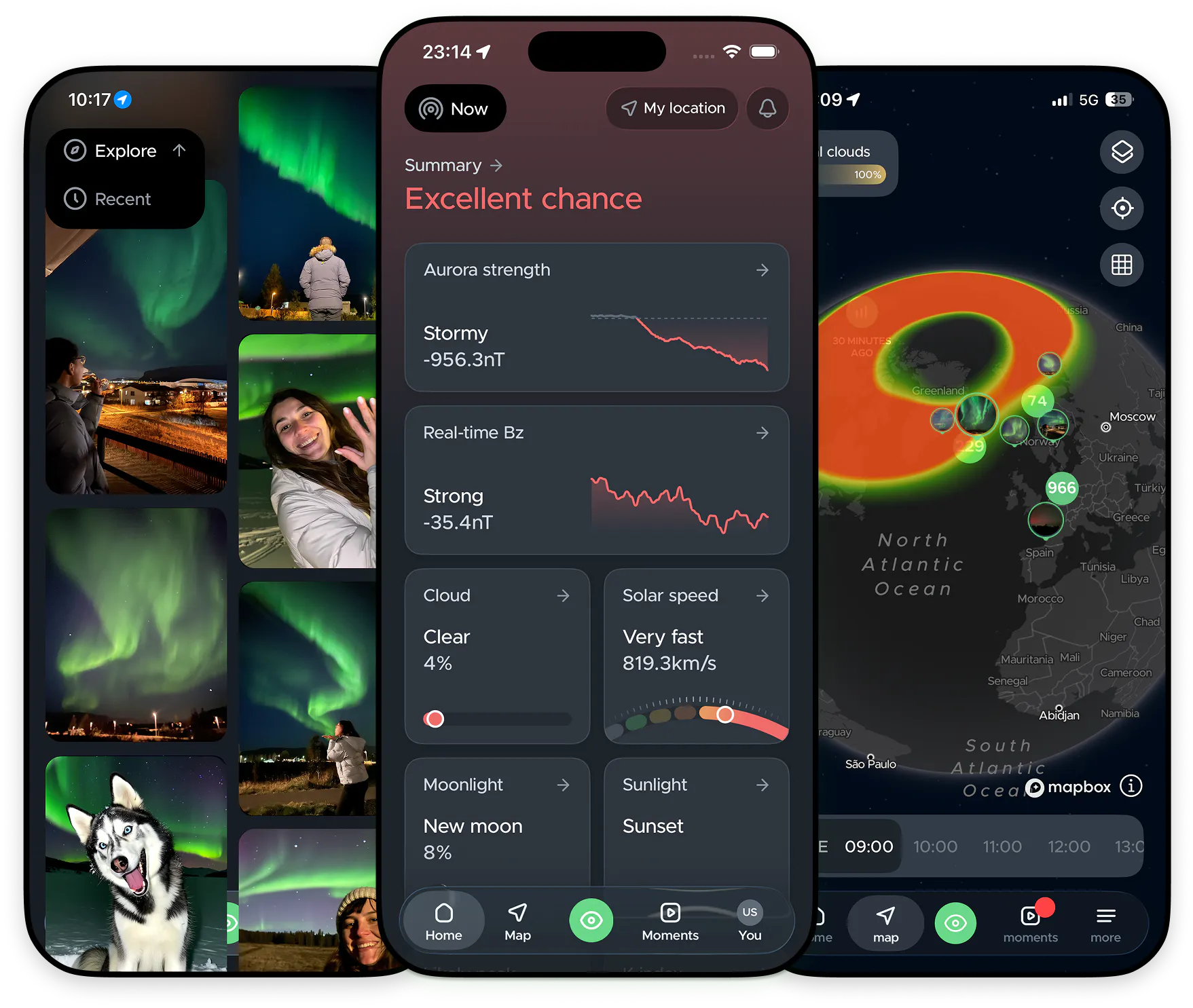
It provide you with everything you need when hunting for the Northern Lights such as real-time aurora forecasts, real-time sightings from users in the locations, cloud coverage data, and explanation of each metrics.

Here are a few reasons why more than 250,000 people registered in the Hello Aurora app and why it has a 4.5-star rating on the App Store in November 2025.

Hello Aurora rated 4.5 star review on App Store and trusted by Hello Aurora hunters

Screenshot from App Store displaying Hello Aurora rating in November 2025.

Real-time aurora forecast

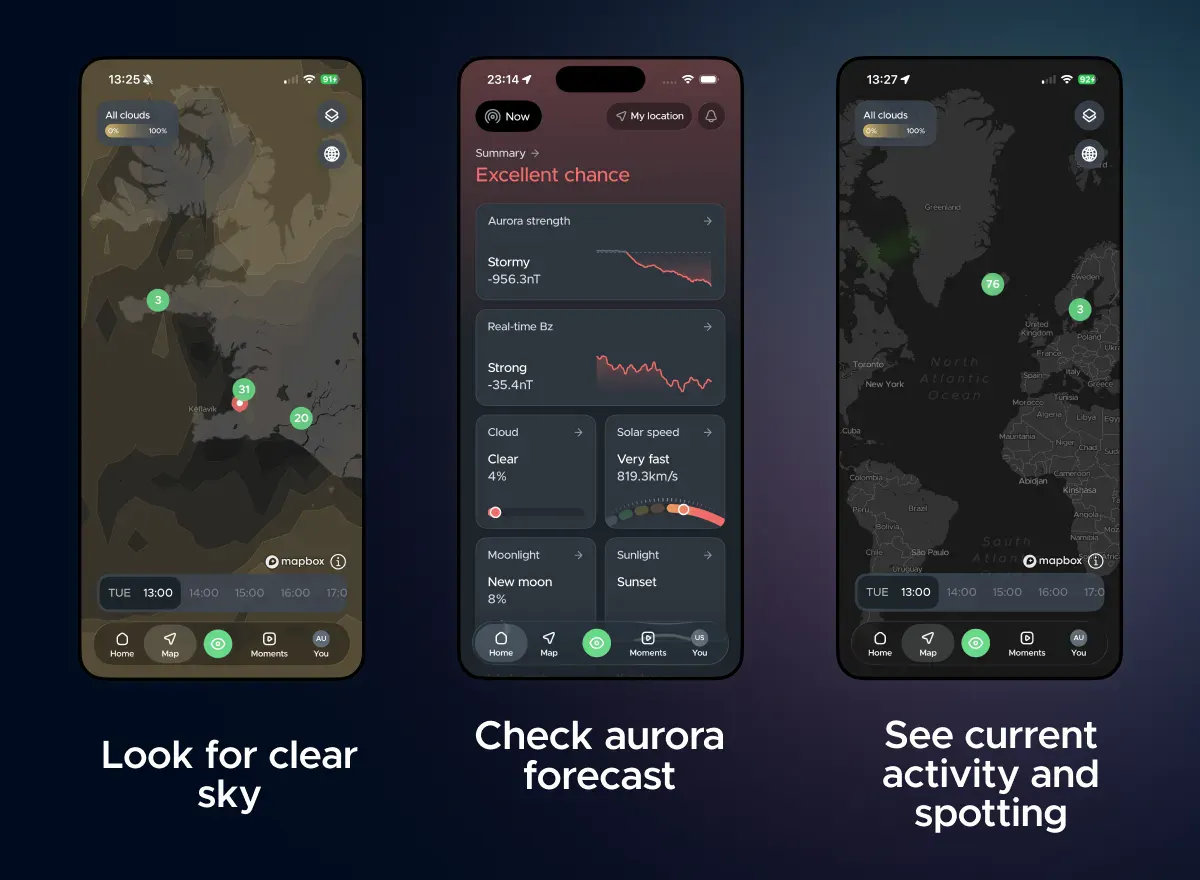
Hello Aurora gives you up to a few minutes of updates on aurora activity so you can see current activity along with predictions to plan your aurora hunting night. The app focuses on tracking geomagnetic substorms, which are the true engines of aurora displays. It moves beyond the simpler KP-index model, which is not accurate for real-time viewing.

Hello Aurora is helpful for aurora hunters to see current activity based on their location without the need to jump between multiple tools to get forecasts. This way, they can focus on what's really happening rather than browsing.

Hello Aurora app provides real-time aurora forecast and easy explanation of aurora metrics that matters for aurora hunting.

Hello Aurora app provides real-time aurora forecast and easy explanation of aurora metrics that matters for aurora hunting.

User-friendly and easy to understand

Hello Aurora provides you with a beautiful design that takes into consideration user-friendliness and easy language. Each tab displays important metrics for aurora hunting and provides easy-to-understand icons, colors, and language that even those with non-scientific backgrounds or first-time aurora hunters can understand.

No-ads

Since 2019 Hello Aurora does not support ads, even on the free version. It allows you to access all the information you need for aurora watching without ads-interruptions during those important moments.

The UI design is simple and neat. The app does what it's supposed to do. I love the aurora gradient over the map. Please keep the app ad-free as it is usually what ruins the user experience.

Hello Aurora apps send notification when the aurora is visible and provide users with easy to understand explanations. It's beginners friendly but packed with useful informations for pros.

Hello Aurora apps send notification when the aurora is visible and provide users with easy to understand explanations. It's beginners friendly but packed with useful informations for pros.

Alerts that are optimized for your location on your smartphone

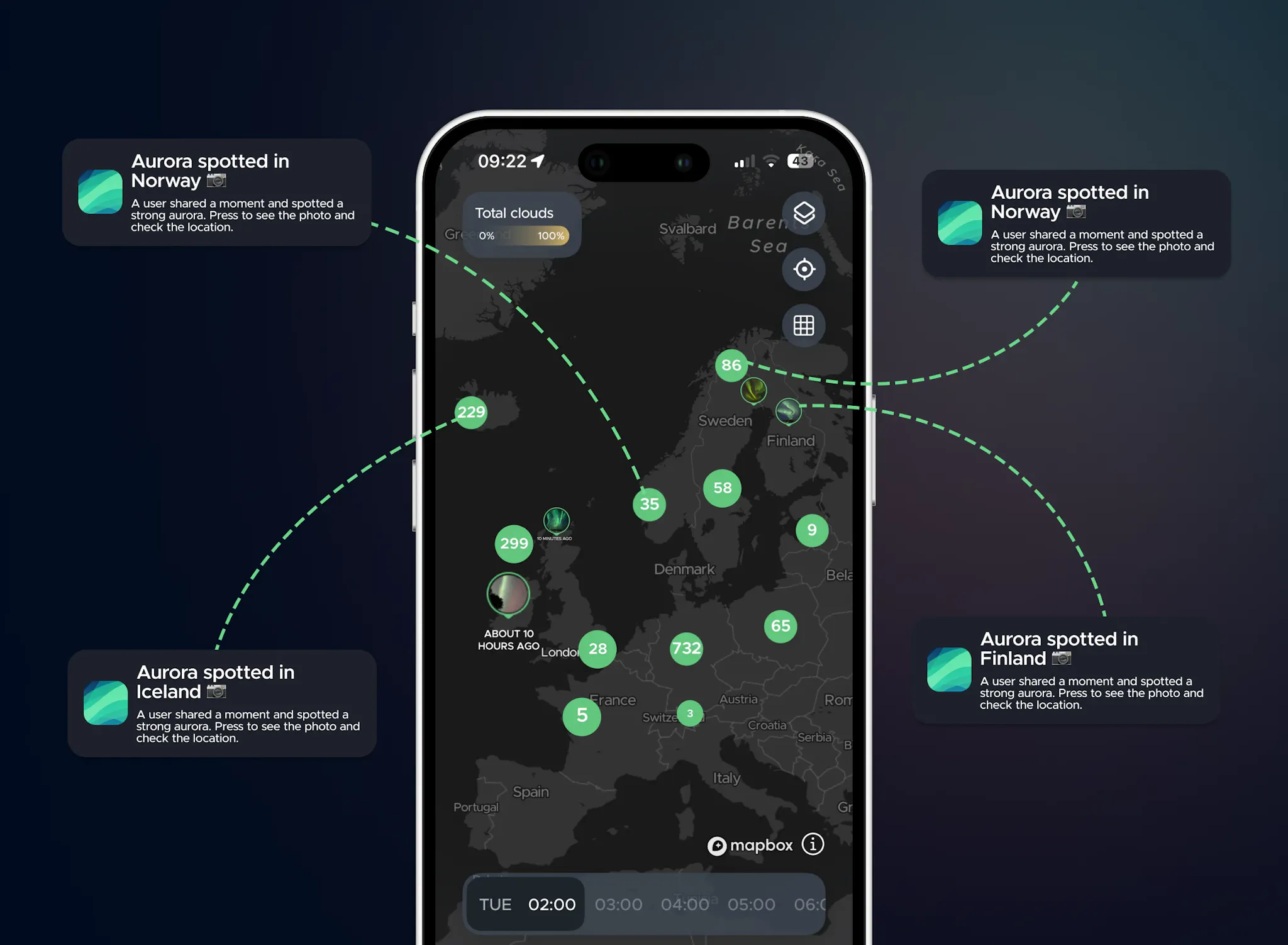
Hello Aurora sends you notifications when the aurora is visible nearby with calculations of weather, astronomy, and aurora activity. The app will provide you with push notifications that actually increase your chances.

Real-time alerts from real people

Hello Aurora allows users to share their aurora spotted reports with photos and locations when they see the Northern Lights. It calculates using aurora possibility at the user's location to prevent false reports. Since the beginning of 2025, there has been more than 24,000+ aurora spotted on Hello Aurora app.

The app also provides other fun features, such as a feature to track your aurora spotted stats, allowing you to see how many auroras were spotted and see your aurora moments in one place.

Proof that it works: how Hello Aurora's real-time sightings help a user spotted the Northern Lights for the first time after 70 years waited.

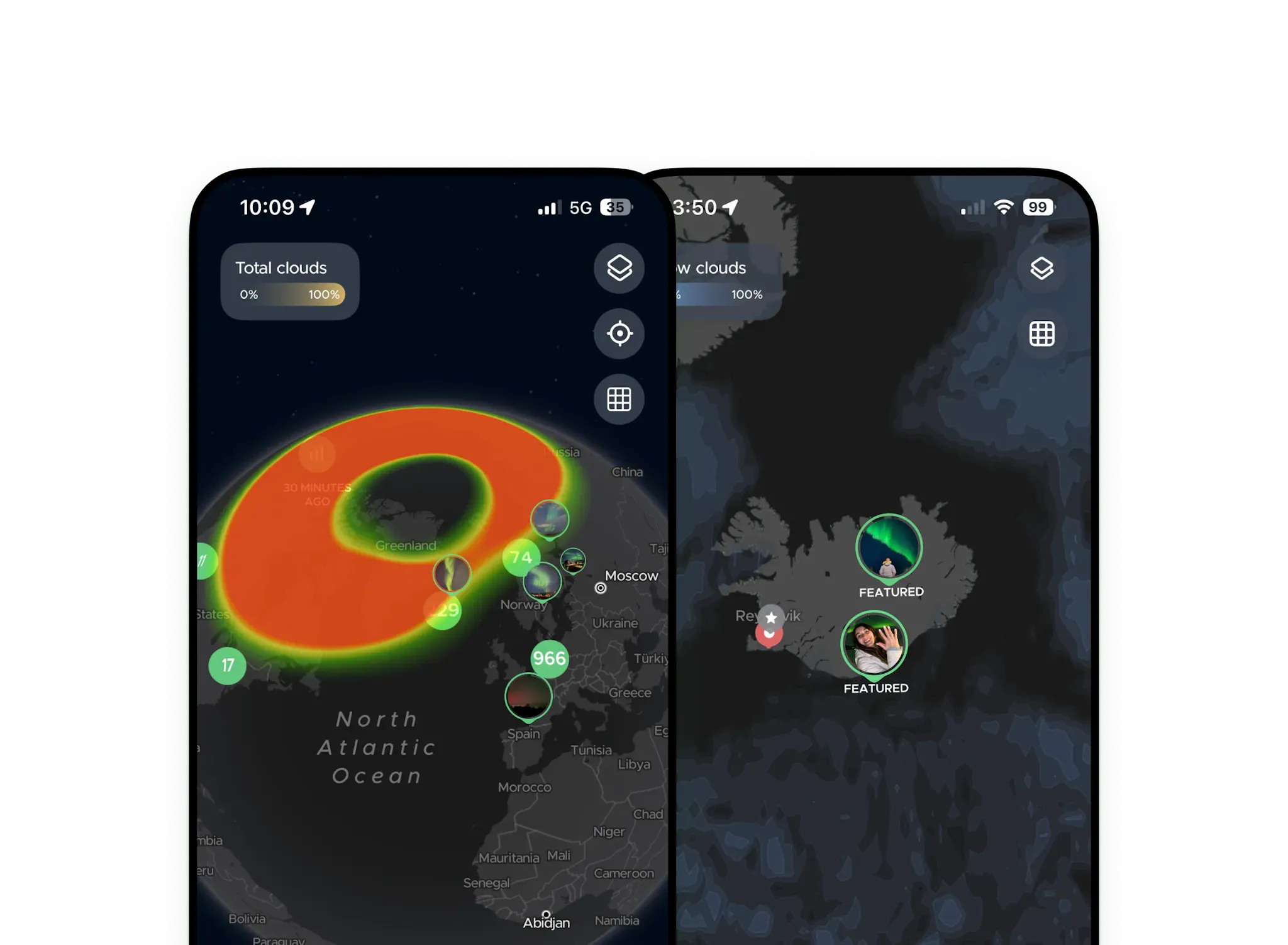
Hello Aurora provides users with real-time data of the aurora activity and aurora hotspot location

Hello Aurora provides users with real-time data of the aurora activity and aurora hotspot locations.

Hello Aurora's pros and cons

Pros

Cons

Accurate real-time forecast

Required account creation due to community features

Live aurora alerts and photos

Data are limited for USA and Canada

No ads

Can share location and photos

Cloud coverage for Iceland, Norway, Finland, Sweden and UK

Substorm push notifications

Aurora alerts notification

Aurora Oval

Add custom locations

Easy to understand

Aurora community

Offer free version

Support dark mode

Track aurora viewing stats

2. Aurora Dashboard by NOAA Space Weather Prediction Center (SWPC)

The Space Weather Prediction Center offers a scientifically grounded, real-time aurora forecast using the OVATION Prime model.

This is a top choice for those who want to go straight to the source. It uses the OVATION model to provide a 30-90 minute forecast of the aurora's location and intensity.

It also provides a 3-day forecast and raw data on solar wind speed, density, and magnetic fields (Bt and Bz). This is a reliable, data-rich resource for those who understand the science behind aurora forecasting.

NOAA’s official aurora dashboard provides users with information about current aurora activity.

NOAA’s official aurora dashboard provides users with information about current aurora activity.

NOAA's pros and cons

Pros

Cons

Official government source

Interface can be technical and overwhelming for beginners

OVATION model

Can be difficult to navigate the website

Free

No ads

Data-rich resource

3. Space Weather Live

Spaceweather provides a range of space weather information. It provides real-time data on solar wind speed and magnetic fields (Bt and Bz), coronal hole activity, sunspots, and solar flares. This level of detail is excellent for those who want to "do it themselves" and interpret the raw data.

The site and app are run by a respected non-profit organization, and its news and articles are well-written and informative. It's a great place to learn about the underlying physics of space weather and how it affects everything from auroras to radio communications.

Spaceweather.com provides a global overview of space weather conditions, making it useful for understanding the broader context of auroral events. The tools are available both as a web app and a mobile application. While the tools provides aurora forecast information, the free version includes ads.

Space Weather Live website provides users with data for aurora forecasting.

Space Weather Live website provides users with data for aurora forecasting.

Space Weather Live 's pros and cons

Pros

Cons

Rich in space informations

Extensive data can be overwhelm for beginners

Reliable real-time data

Free version have ads

Offer free version

App version provide push notifications

Provide multiple languages

Provide report and news about space weather

Offer dark mode

Conclusion

The best tools help you understand and increase your chances of seeing the lights by showing what is happening in aurora activity.

No tool will magically guarantee your chance of seeing the lights, but they are helping you foresee what to expect while traveling.

Remember, the Northern Lights are a natural phenomenon. While certain tools will definitely tell you about higher chances to see the lights, you may want to try them and use your own decision and keep looking up for clear skies. Do not rely on the KP index alone.

FAQ

Q: What does an aurora forecast app do?

A: Most aurora forecast apps tell you whether the Northern Lights might be visible, usually relying on broad space weather data. Some go a step further by adding local weather forecasts and alerts. Hello Aurora goes beyond that. It gives you personalized, location-based forecasts tailored to the conditions where you are, so you get insights that truly maximize your chances of experiencing the aurora. On top of that, the app provides cloud coverage maps for Iceland, Norway, Finland, Sweden, and the United Kingdom, a critical factor for successful aurora hunting.

Q: How accurate are aurora forecasts?

A: Hello Aurora’s real-time aurora forecast updates every few minutes, giving you the most accurate prediction possible for seeing the Northern Lights. While no app can guarantee 100% accuracy, auroras are naturally unpredictable. Hello Aurora uses the latest data to provide the best possible chance of spotting them. Auroras can change rapidly, and forecast accuracy decreases the further into the future you look. That’s why we recommend using short-term forecasts (1–3 days) for planning, while treating long-term forecasts as a guideline. Checking the real-time data on the day and even by the hour helps you make the most informed decision about when and where to chase the lights.

Q: What is the KP index?

A: KP Index is a global scale (0–9) measuring geomagnetic activity.

Higher KP values mean a stronger chance of auroras being visible farther south (or north in the Southern Hemisphere). If you're already in a place where auroras are common, you don't need to worry much about KP numbers.

Q: Can the app tell me exactly when auroras will appear?

A: Aurora forecasting tools can not predict the exact minute auroras will show up, but the best ones can give you pretty good warning when conditions are about to get exciting.

When Hello Aurora app detects that a "substorm" is building, it will send you an alert saying "Minor substorm in XXX, you might see aurora by eyes" These alerts are quite reliable when they happen.

Q: Why can't apps be more precise?

A: Auroras are natural phenomena, they're inherently unpredictable Sometimes auroras are too faint to see with your eyes but show up in photos. Local factors like light pollution and atmospheric conditions affect what you can actually see.

Q: Can I see auroras if the KP index is low?

A: Absolutely! This is one of the biggest misconceptions about aurora viewing.

If you're in the "aurora zone" - places like:

  • Iceland
  • Northern Norway, Sweden, or Finland
  • Northern Alaska or northern Canada
  • Northern Scotland

you can often see auroras even when KP is just 1 or 2. These places sit right under where auroras naturally occur, so you don't need major high KP to see them.

Don’t rely too much on the KP index. Many people miss incredible auroras because they think the KP has to be high, or they go out when it is high and still see nothing. In aurora zone, it’s much better to watch real-time local data than global KP numbers.

Q: What KP do I need to see the aurora

A: This depends entirely on where you are. Think of it like this: the closer you are to the North Pole, the less KP you need to see auroras but if you are further south like in Germany you will need a higher number.

Bottom line: Don't just focus on KP numbers. If you're in a good aurora location, check your app regularly and head out whenever it shows promising conditions, regardless of the KP level!

Share

Get started

Don't wait any longer, download hello aurora and start exploring!