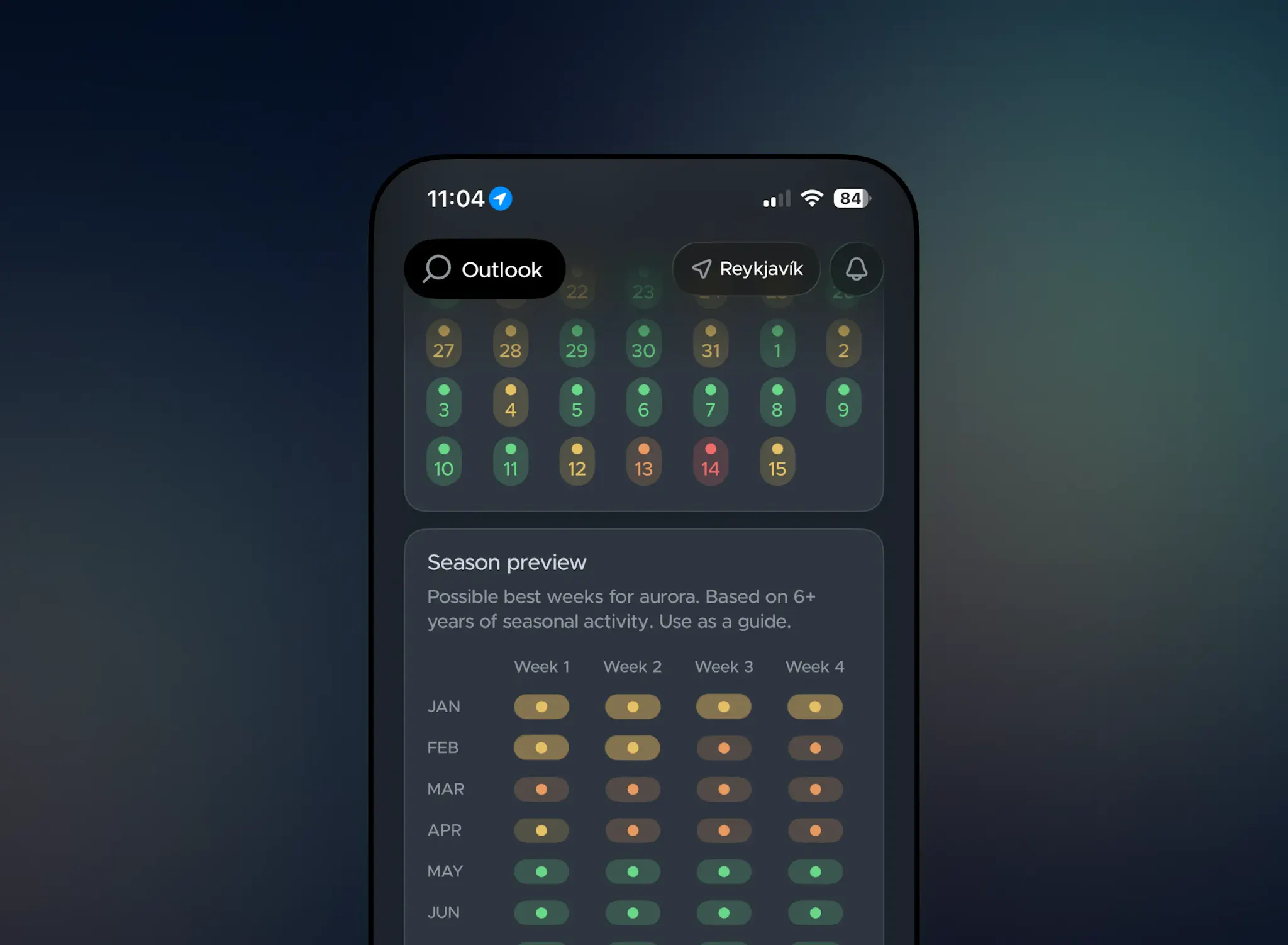
Aurora forecast metrics to use
If you talk to experienced tour guides and professional aurora hunters in the field, they will tell you one main rule: ignore the Kp Index.
The Kp Index is a three-hour planetary average pulled from thirteen stations around the world. Because it averages activity over massive time frames and includes areas far outside the Arctic, it is often delayed and inaccurate for your specific location.
Experienced chasers know that relying on Kp alone means missing brief, intense substorms that happen right above your head. Instead of a delayed global index, professional hunters rely on real-time aurora forecast updated every few minutes:
- Aurora Strength: Measures live changes in Earth's magnetic field right near your location. This gives you an immediate go-or-no-go signal.
- Interplanetary Magnetic Field (IMF) Bz: Tracks the north-south direction of the magnetic field. A negative (southward) Bz opens Earth's magnetic shield, letting solar energy stream in to power the display.
- Real-Time Solar Wind (RTSW): Live solar data from space weather satellites. It gives you early warning before incoming solar activity hits Earth.
- Cloud Coverage: High thin clouds still let bright auroras show through, but thick low clouds block everything. Professional guides monitor clouds maps to find localized gaps in the cloud layer.
By opening Hello Aurora, you get direct access to local magnetometer readings, real-time forecasts, cloud coverage, substorm alerts and instant crowd reports mapped near you.
How to hunt the Northern Lights on your own
Check conditions around sunset
Open Hello Aurora app around sunset.
Look at the Aurora Strength, Bz directions, and cloud maps.
Find where low clouds break, and plan your drive toward those clear patches.
Prepare your gear
- Transport: Rent a reliable car suitable for winter driving, recommend to must have a 4x4
- Clothing: Layer up with thermal base layers, insulated boots, thick gloves, and windproof outer gear.
- Tools: Bring a headlamp with a red-light mode to protect your night vision.
Find the right spot
Drive away from citylights. Look for an open field, a frozen lake or a hilltop facing north. If you have time during daytime scouting is helpful so you can locate safe parking spots before darkness falls.
Caution is necessary when driving on icy Arctic roads at night. Always check road conditions before heading out, and pull over only in safe, designated areas.
The waiting game
If Hello Aurora shows dropping Aurora Strength values (into negative numbers) along with a negative Bz, stay patient. The lights can appear suddenly or take hours to build up.
If you see faint white streaks in the sky, test it with your phone or camera using long exposure. Camera sensors absorb light much better than human eyes and can instantly reveal hidden green tones.
If your current area gets cloudy or shows no activity, check your live cloud map and navigate to a nearby open area.
Turn on aurora alerts
Turn on notifications in Hello Aurora so you get instant alerts when conditions align at your location or when a substorm starts expanding.
When you get an aurora spotted alert from another user, look up at the sky around you and take a test photo. Auroras are visible from far away, so a sighting reported 25 km from you may already be visible in your sky. Taking a quick long-exposure photo helps verify faint colors right away.