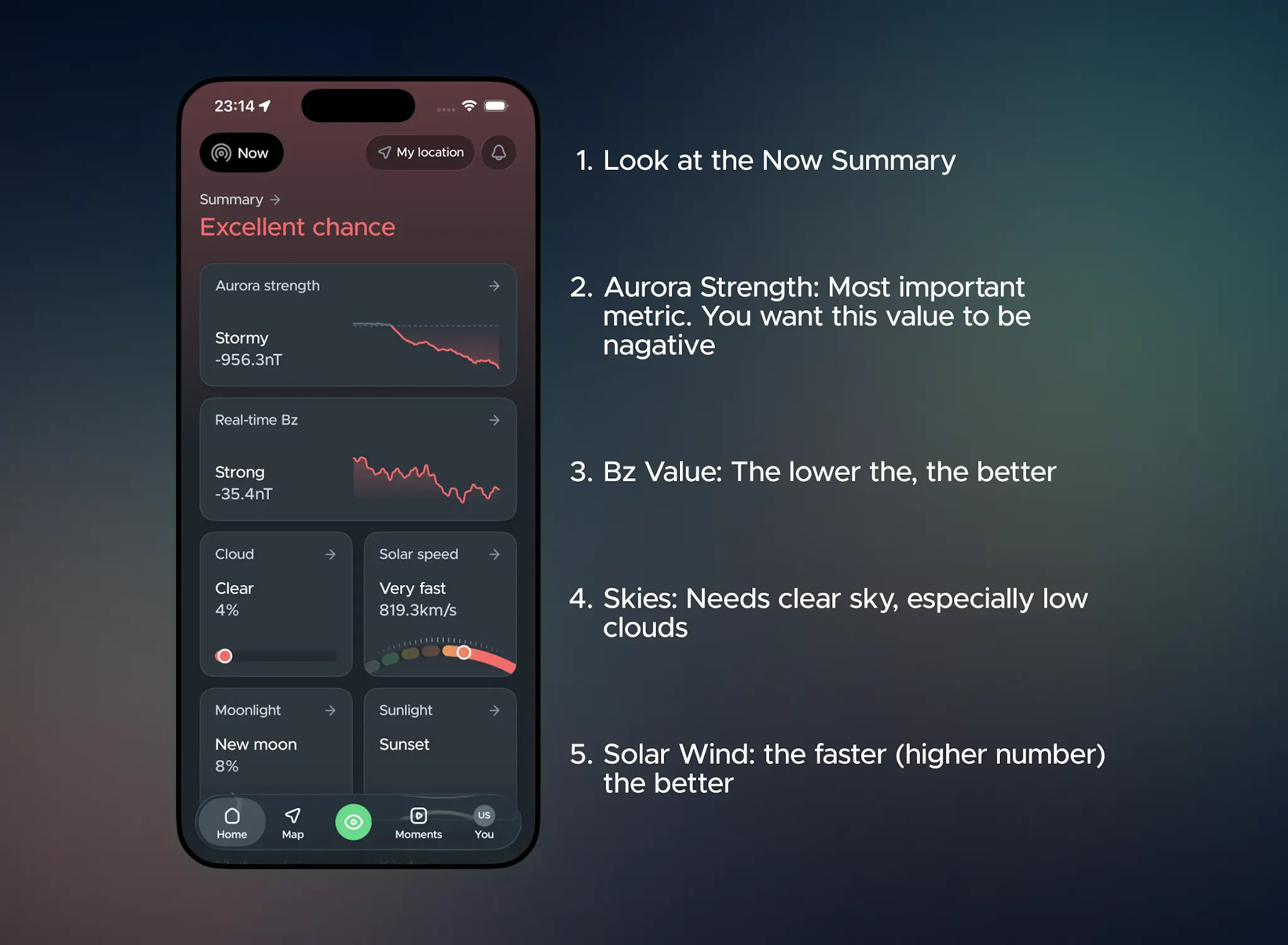
- Localized location alerts: Hello Aurora uses your exact GPS coordinates in Sweden. It combines live solar wind data, local cloud cover, and darkness levels to send alerts when conditions favor your area.
- Instant Aurora Spotted reports: When another user spots the lights in Sweden, they can post a photo (a Moment) or report a sightings. You receive an instant push notification when sightings occur.
- Local magnetic sensor tracking: Hello Aurora connects to local magnetic stations across Sweden. You get alerts when real-time readings like southward Bz drop, indicating an active display may be starting.
Combining live magnetic data with real-time ground reports helps you step outside at the right moment.
Pro Tip: Timing is everything in the south. To stay ahead of the curve, download the Hello Aurora app. It simplifies complex data into easy-to-understand "probability" percentages. More importantly, it features real-time user reports. You’ll get a push notification the second another user in Sweden spots the lights, so you can head outside exactly when the magic happens.
2. Find a good location
To see the aurora, you must avoid light pollution and clouds. City lights in Stockholm or Kiruna will wash out the colors. Thick clouds will block your view entirely. Use a cloud coverage map to find clear skies. Look for a spot with an open view of the northern horizon.
The aurora often starts as a faint green arc low in the sky. It may look like a pale or greyish mist. Trust your camera more than your eyes in the dark. Our eyes struggle to see colors at night.
Modern phone cameras are very sensitive to light. Point your phone north and take a Night Mode photo for three to five seconds. If the grey mist looks bright green on your screen, you have found the aurora.
3. Timing is everything
The best window to see the aurora in Sweden is typically between 10:00 PM and 2:00 AM. However, during high solar activity, they can appear as early as 6:00 PM. Keeping an eye and turn on the notification on Hello Aurora so you will not miss it.
Top 3 best places to see the aurora in Sweden in 2026
If you are a tourist traveling to Sweden specifically for this spectacle, these are your best bets:
1. Abisko National Park
Abisko is world-famous because of its unique microclimate. Surrounded by mountains, it often has a "blue hole" of clear sky even when the rest of Lapland is cloudy. The Aurora Sky Station here is arguably the best viewing spot on Earth.
2. Kiruna & Jukkasjärvi
As Sweden's northernmost city, Kiruna is the perfect base. You can stay at the famous Icehotel in nearby Jukkasjärvi and join guided snowmobile or dog-sledding aurora tours.
3. Luleå
For a coastal experience, Luleå offers a stunning backdrop. Watching the green lights reflect off the frozen sea of the Bothnian Bay is a photographer's dream.
Frequently Asked Questions (FAQ)
Q: Can I see the Northern Lights in Stockholm ?
A: Yes, but only with a strong geomagnetic storm. Get Hello Aurora app for real-time forecast and get substorm notification so you will not miss the Northern Lights when they show up in Stockholm.
Q: Is 2026 a good year for the Northern Lights in Sweden?
A: Yes, according to experts. 2026 is another good year for aurora lovers.
Q: Do I need a tour to see them?
A: Not necessarily, but tours are great to increase your success as they are the local expert and know where to go. Especially, during a cold dark hours, you might not want to wandering around the arctic by yourself.