Geomagnetic Storms Alert & the Northern Lights

Blog · Published: 27 November 2026

Geomagnetic Storms Alert & the Northern Lights's cover picture

What a geomagnetic storm is, how the NOAA G-scale works and how to get G-scale alerts so you will not miss the next big storm.

A geomagnetic storm is a major disturbance in Earth's protective magnetic field (the magnetosphere) caused by charged solar particles streaming from the sun.

This energy transfer peaks when the Interplanetary Magnetic Field (IMF) points south. Because a southward magnetic field opposes Earth's own field, it acts as an open door for solar energy to rush inside and trigger the Northern Lights.

What triggers geomagnetic storms

The most intense geomagnetic storms are driven by two main events on the sun:

  • Coronal Mass Ejections (CMEs): Massive explosions on the sun hurl a billion tons of solar material and magnetic fields into space. Most CMEs take a few days to reach Earth, though the strongest ones arrive in just 18 hours.
  • High-Speed Streams (HSSs): Fast-moving rivers of solar wind slam into slower solar wind ahead of them. This collision creates compressed zones that steadily push energy into Earth's magnetic field over several days.

How scientists measure space weather

During a storm, powerful electrical currents flow through Earth's magnetic field and upper atmosphere. Scientists at the National Oceanic and Atmospheric Administration (NOAA) and the National Aeronautics and Space Administration (NASA) track these currents using specialized metrics:

  • Planetary K-index (Kp Index): A global score based on magnetic shifts collected from 13 observatories worldwide. NOAA uses this score to set its G-Scale for space weather severity. Learn what the Kp numbers mean and which ones give you chance of seeing the Northern Lights.
  • Disturbance Storm Time (Dst) Index: Measures a ring of electrical current circling Earth that causes magnetic shifts on the ground.

Understanding the NOAA G-Scale

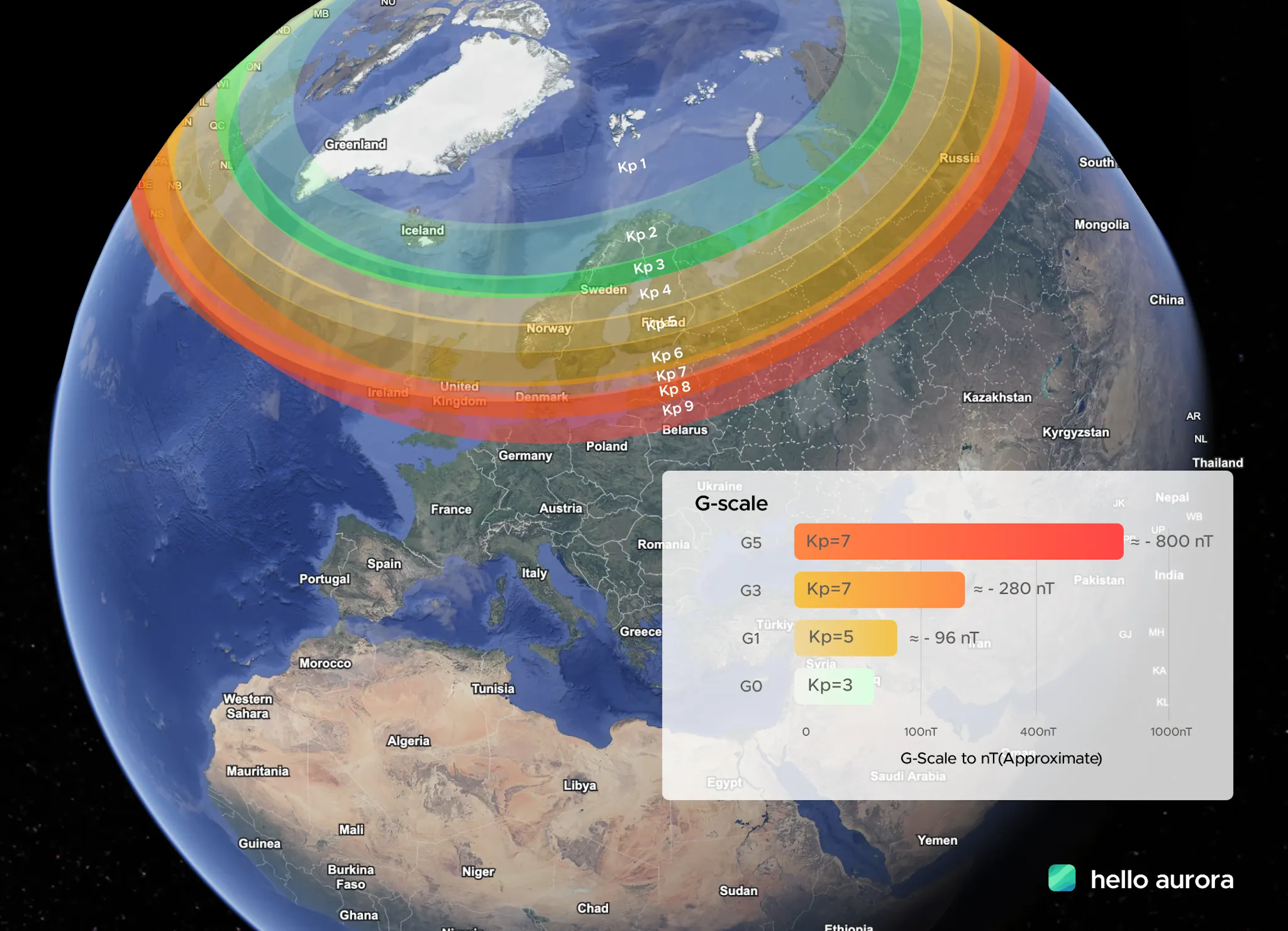
NOAA rates storm severity and potential impact using a five-level G-scale linked to the Kp index:
Scale

Description

K-Index

G 5

Extreme

Kp 9

G 4

Severe

Kp 8 to 9-

G 3

Strong

Kp 7

G 2

Moderate

Kp 6

G 1

Minor

Kp 5

Map showing how aurora visibility changes with latitude at different Kp index levels during geomagnetic storms.

Map showing how aurora visibility changes with latitude at different Kp index levels during geomagnetic storms.

Why higher G-scale storms push the Northern Lights further south

Under normal conditions, Earth's magnetic field funnels charged solar particles toward the magnetic poles. This creates a ring around the polar regions called the auroral oval. That is why the Northern Lights usually stay in high-latitude destinations like Norway, Sweden, Finland, Iceland, and northern Canada. During a G4 or G5 geomagnetic storm, this pattern changes fast:

  • Massive energy injection: Huge volumes of solar plasma slam into the magnetosphere.
  • Magnetic compression: Pressure distorts and stretches Earth's magnetic field lines.
  • Expanding aurora oval: The auroral oval stretches toward the equator, shifting the drop zone so people far outside the Arctic can witness the lights.
The Northern Lights spotted in central France during G4 on January 2026

The Northern Lights spotted in central France during G4 on January 2026

Recent examples of storms pushing auroras further south

Intense solar activity during Solar Cycle 25 has triggered several major storms that brought the Northern Lights to unexpected places:

  • The January 2026 Storm (G4 Severe): On 19 January 2026, a fast solar storm pushed activity to extreme levels. Users in countries like France and Germany shared bright Moments on the app, and sightings stretched across Central and Eastern Europe as far south as Romania.
  • The June 2025 Storm (G4 Severe): Triggered by a powerful solar flare and a full-halo CME on 1 June 2025, this storm sparked bright aurora sightings across France, Germany, Switzerland, northern US states, and Canada.
  • The May 2024 Gannon Storm (G5 Extreme): The strongest storm since 2003 lit up skies far outside the Arctic Circle. Hello Aurora users verified sightings across northern Mexico and much of the continental United States, including California, New York, Florida, and Georgia.

How to track geomagnetic storms and get alerts

Knowing what is happening in space gives you a head start of possibility to see the Northern Lights further south. Hello Aurora sends you instant space data alerts at every stage of an approaching storm so you know exactly when to look up:

Easily turns on notification to receive geomagnetic storm alerts days in advance under notification's setting on Hello Aurora.

Easily turns on notification to receive geomagnetic storm alerts days in advance under notification's setting on Hello Aurora.

  • Geomagnetic Storm Watch Alerts (days ahead): When NOAA expects a solar storm to reach Earth within 3 days, we notify you the moment the watch is issued so you can plan ahead. (Note: A watch is only an early forecast, as true strength isn't confirmed until the storm gets closer.)
  • Solar Wind Shock Alerts (up to an hour ahead): We alert you 30 to 60 minutes before the solar wind shock hits Earth (when its real strength and magnetic direction are finally measured) and again the moment it arrives.
  • Substorm Notifications (right now): We check your local sky darkness and nearby magnetic readings to let you know when a bright, fast-moving aurora burst begins overhead.

Frequently asked questions

Q: What is the best app for Northern Lights alerts?
A: Hello Aurora provides real-time tracking, sending geomagnetic alerts, solar wind shock alerts, local substorm notifications and community sighting alerts.

Q: How do I get notified when lights are visible near me?
A: Enable aurora sightings push alerts in Hello Aurora and we will send you notifications when someone spotted the Northern Lights.

Q: Does a G1 storm guarantee the Northern Lights?
A: No. Visibility depends on local cloud cover, darkness, light pollution, and a southward Bz magnetic field.

Q: What is the difference between a storm watch and a solar wind shock alert?
A: A storm watch is a forecast issued up to 3 days ahead. A solar wind shock alert triggers 30 to 60 minutes before the storm actually impacts Earth.

Q: How can I plan an aurora trip months in advance?
A: Use historical data. Hello Aurora offers a 12-month seasonal outlook built from 6 years of archives and a 27-day guide based on the sun's rotation cycle.

Get started

Don't wait any longer, download hello aurora and start exploring!
Download on the App Store
Download on the Play Store