Long term aurora forecast: how to plan 27 days to 12 months

Blog · Published: 10 November 2026

Long term aurora forecast: how to plan 27 days to 12 months's cover picture

How to use a long term aurora forecast. Learn to read the 27 day Guide and 12 month Outlook and pick the best week for the Northern Lights.

What is a long term aurora forecast?

A long-term aurora forecast shows when the Northern Lights are more statistically likely in the weeks and months ahead. While it cannot promise an exact light show on a single designated night, it helps you choose travel dates, manage expectations and understand solar patterns.

The Northern Lights occur when charged solar particles collide with gases in Earth's upper atmosphere. Solar energy, local cloud cover, geographic location, and light pollution all influence visibility, meaning exact minutes cannot be predicted far in advance.

The 27-day solar rotation cycle

The Sun's rotation takes about 27 days. A sunspot or coronal hole that sparked the lights 27 days ago may face Earth again though it may also fade.

NOAA's Space Weather Prediction Center (SWPC) publishes a 27-day outlook forecasting solar radio flux and geomagnetic indices, including the Kp index. Hello Aurora enhances this baseline forecasting by synthesizing outlook data with historical observational records. We integrate metrics on past auroral intensity, the interplanetary magnetic field Bz​ component, verified user reports, cloud cover, and lunar illumination.

How to choose the right forecast

Each forecast answers a different question. Use all three in order

  • 12 month Outlook: which week should I book?
  • 27 day Guide: which nights look best on my trip?
  • Real-time forecast: is it happening right now?

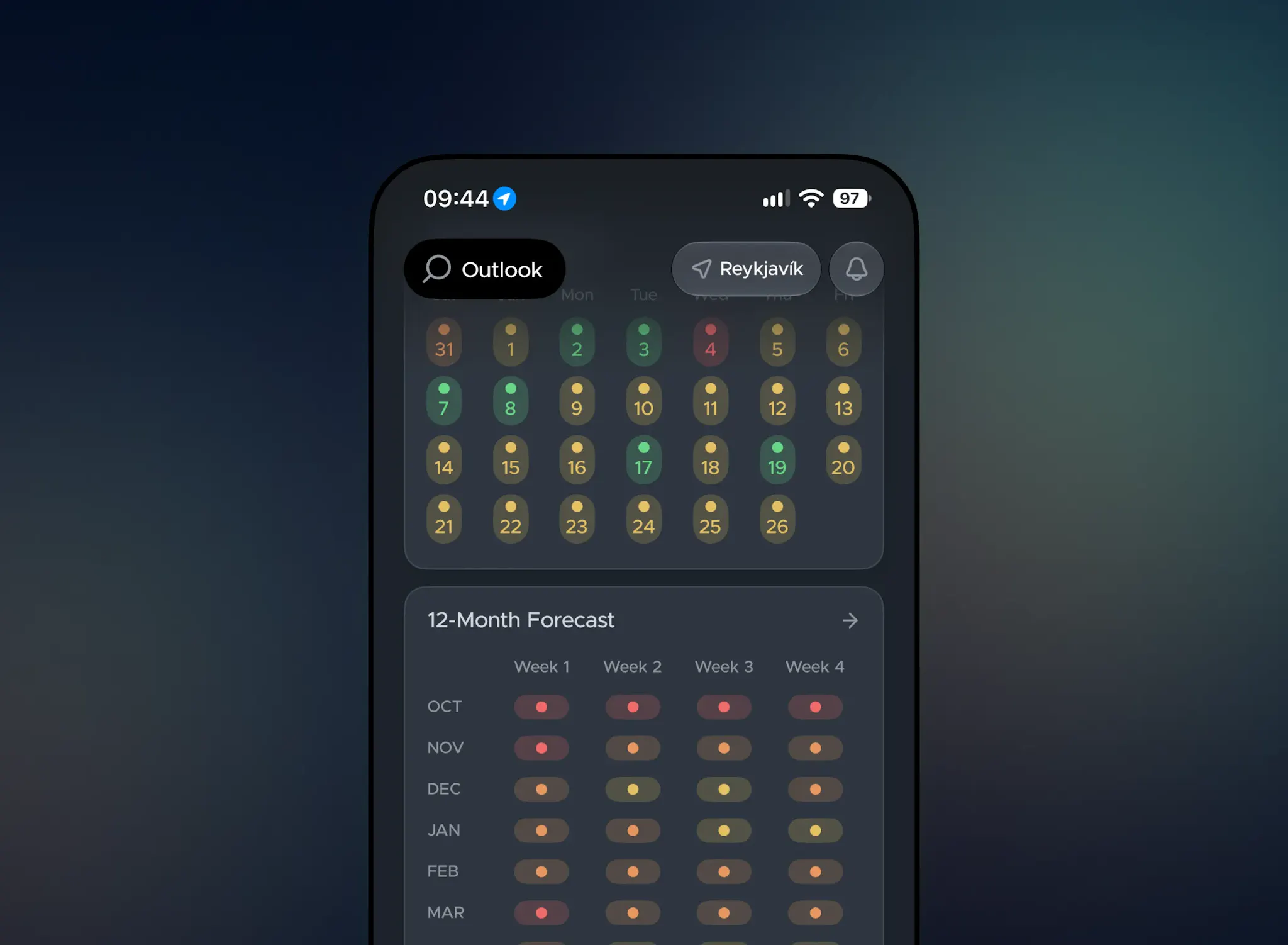
How to find the best week with the 12 month forecast

Check Hello Aurora for long term 12 months aurora forecast

Check Hello Aurora for long term 12 months aurora forecast

Step 1: Open the Outlook tab

Navigate to the Outlook tab in the Hello Aurora app. Set your target travel destination or current location to view a color-coded calendar covering the upcoming months.

Step 2: Read the color-coded scoring

Scoring models evaluate over six years of historical solar activity, local cloud cover patterns, and verified user sightings:

  • Grey: Poor conditions
  • Green: Low probability
  • Yellow: Moderate probability
  • Orange: Good probability
  • Red: Excellent probability

Step 3: choose your travel dates

Target orange or red weeks when possible. Always book a multi-night stay (atleast 5 to 7 nights) rather than a single evening, as localized weather and solar fluctuations change nightly.

How to plan your nights with the 27-day forecast

Check long term 27 days Northern Lights forecast easily on Hello Aurora app

Check long term 27 days Northern Lights forecast easily on Hello Aurora app

As your travel dates approach, shift to the 27-day forecast to evaluate individual nights.

Step 1: Open the Guide tab

Go to the Guide tab in the app. Use the timeline bar at the top to switch between days.

Step 2: check the color and summary

Free users see a color for each night. It goes from grey for poor to red for an excellent chance. Each day also has a short summary in plain language. You can see cloud cover, moonlight, sunlight and the KP index forecast too.

Step 3: Review the previous solar cycle

Hello Aurora combined historical solar cycle along with future prediction to help you plan and see the future forecast

Hello Aurora combined historical solar cycle along with future prediction to help you plan and see the future forecast.

Pro users can view data from exactly 27 days prior to evaluate repeating solar structures. Key metrics to monitor include:

  • Aurora Strength: Measures real-time fluctuations in Earth's magnetic field in nanoteslas. Values of -150 nT or lower indicate active conditions; increasingly negative numbers correlate with brighter displays.
  • Bz component: Represents the north-south orientation of the Interplanetary Magnetic Field (IMF). Negative Bz values connect with Earth's magnetic field, and readings of -10 nT or lower frequently trigger visible aurora displays.
  • User sightings and peak hours: Tracking local and worldwide report volumes reveals historical activity levels and typical peak viewing times.

Use the real-time Northern Lights forecast on location

A long term forecast can change. An excellent night can drop to moderate. A weak night can turn good. Always check the Now tab on the night for the most up to date and accurate forecast.

Hello Aurora's real-time forecast uses the magnetometer closest to your GPS location. It updates every few minutes and shows what matters where you stand. We recommend to

  • Turn on notifications to get alerts when your chances rise.
  • Get alerts when someone nearby spots the lights.
  • Pro users can set alerts for people near you only. They can also set Bz and substorm alerts.

Summary

Use the 12 month Outlook to pick your best week. Use the 27 day Guide to find your best nights. Use the real-time forecast and alerts to catch the lights when they appear. Download Hello Aurora to use all three.

Frequently asked questions

Q: How do I get a long term aurora forecast?
A: Open the Guide tab in Hello Aurora for the next 27 days. Open the Outlook tab for the next 12 months.

Q: How do I find the best week for the Northern Lights?
A: Open the Outlook tab and look for red weeks. Orange weeks are also good. Each week is scored from 6 years of data.

Q: Can red or orange color guaranteed my chance?
A: No. No one can 100% guarantee the Northern Lights because conditions change constantly. Visibility depends on unpredictable factors such as sudden shifts in solar activity, sudden cloud cover or storms and light pollution.

Get started

Don't wait any longer, download hello aurora and start exploring!
Download on the App Store
Download on the Play Store